Live online blackjack UK: real dealer tables and the true house edge
Live online blackjack is sold on the best return in the building. The number usually quoted is not the number on the table. Here is the rule set that actually runs, what it returns, and the two places the edge quietly multiplies.
Reviewed
- Live table return
- 99.28%
- House edge
- 0.72%
- Side bet edges
- 3.70–6.18%
- Shoe penetration
- ~50%
Blackjack has a reputation among online blackjack UK players, and it is mostly deserved. Played properly it gives back more than almost anything else in a casino. The trouble starts with which version of properly, and which version of the table. Nearly every page about live online blackjack quotes a return of about 99.5%. The classic live table does not offer that rule set, and the gap is worth understanding before you sit down.
What live dealer blackjack actually is
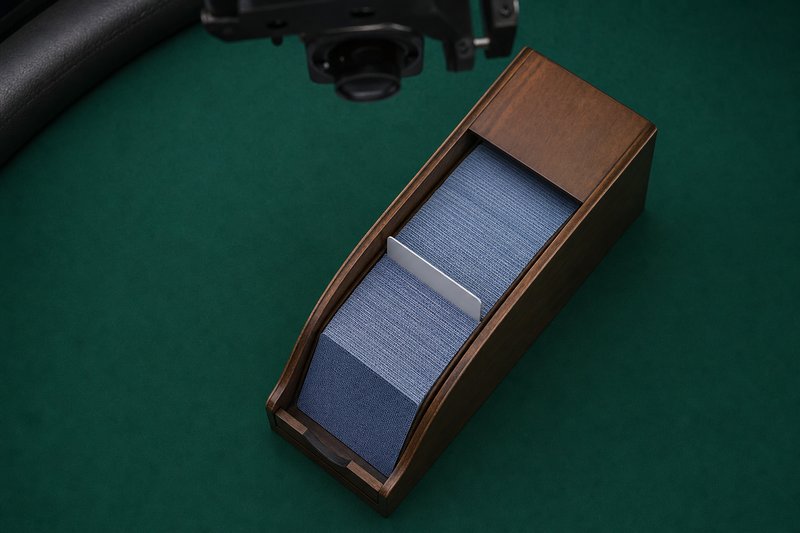
Live dealer blackjack means what it says. A real person deals real cards from a real shoe, filmed in a studio and streamed to you. There is no random number generator deciding the outcome of the hand. That much is confirmed by the testing laboratories rather than by marketing.
The cards are read into the software by optical character recognition. That is how a physical outcome becomes a number the platform can settle bets against. The relevant technical standard even requires a manual mode for when the reader misreads a card. Players must be told when a human is entering results by hand.
Worth knowing, because it is the one genuinely unusual thing about the format.
It also means you should check what you are actually playing. Some products are built to look like a live table while running entirely on a random number generator. No dealer, no video feed. One provider says so plainly in its own annual report. If there is no visible human dealing, it is not live dealer blackjack whatever the lobby calls it.
What live online blackjack really returns at UK tables
The classic eight-deck table runs a specific and fairly tight rule set. The dealer stands on soft 17. You may double on any first two cards. You may not double after splitting, you may split only once, aces cannot be resplit, and there is no surrender. Under those rules the house edge is 0.72%, which is a return of 99.28%. An independent analysis puts the same figure on it as the operator listings do.
| Rule set | House edge | Return |
|---|---|---|
| Often-quoted benchmark (double after split, split to four) | 0.43% | 99.57% |
| The classic live table as actually dealt | 0.72% | 99.28% |
| Infinite Blackjack, with six-card Charlie | 0.45% | 99.55% |
From published blackjack analysis and operator disclosures, eight decks throughout. Infinite Blackjack has three figures: 99.47% from an operator, 99.51% from its own help file, 99.55% from independent calculation.
So the difference between the quoted figure and the real one is about three tenths of a per cent. That sounds trivial and is not. On £5,000 staked across an evening it is roughly £15 of additional expected cost, for rules most players never check. There is a second and much larger gap, and this one is rarely mentioned at all.
A published blackjack return assumes perfect basic strategy on every single hand. That is not an accident of how it is calculated. The regulator’s guidance says that where a game involves skill, the return should be worked out using a standard or published strategy. The figure describes flawless play by design.
Real play is not flawless. Published analysis of land-based players puts the cost of average mistakes at 1.41%, on top of whatever the house edge is. We will not add that to 0.72% and present the total as a live figure. The measurement was not taken online. The direction is clear enough on its own.
For scale, a deliberately simplified strategy chart of twenty-one cells costs about 0.14% against full basic strategy, which runs to roughly 250. The expensive mistake is not using a simplified chart. It is using none. Against that, the average player’s own mistakes cost an order of magnitude more.
Side bets are where the edge really sits
Every live table offers extras, and they are priced quite differently from the hand itself.
| Side bet | Paytable assumed | House edge |
|---|---|---|
| Perfect Pairs | Perfect 25 / coloured 12 / mixed 6 | 4.10% |
| 21+3 | Suited trips 100 / straight flush 40 / trips 30 / straight 10 / flush 5 | 3.70% |
| Any Pair | Suited 25 / non-suited 8 | 4.10% |
| Hot 3 | Three sevens 100 / suited 21 pays 20 / 21 points 4 / 20 points 2 / 19 points 1 | 5.40% |
| Bust It | Eight or more cards 250, down to three cards 1 | 6.18% |
Eight decks. The paytable column is not decoration: a side-bet edge quoted without its paytable and deck count is not a usable figure.
Against 0.72% on the main hand, those run from roughly five to fourteen times the cost. That is the trade being offered, and it is a perfectly legitimate one as long as you know the price. Those prices are not printed beside the bet, which is the part worth objecting to.
The paytable point deserves its own warning. Two tables can both advertise 21+3, look identical, and charge very different amounts. If three of a kind pays 30 the edge is 3.70%. If the same bet pays 25 instead, it rises to 6.29%. One rung on the ladder nearly doubles the cost.
Insurance is the other trap, and here we will not give you a number. The only figure we could source is calculated on six decks. Eight-deck tables are the norm online, so quoting it would be quietly wrong. Basic strategy declines insurance in any case.
Infinite Blackjack, and the rule that pays for the rest
The seat-sharing variants deal one common opening hand to unlimited players, after which everyone plays it independently. On paper the rules are worse than the classic table. Then the six-card Charlie arrives and changes the arithmetic. Reach six cards totalling 21 or less and you win automatically, even against a dealer blackjack. That rule alone is worth about 0.16% to the player, and it turns a 0.61% base into 0.45%.
Which makes it the better table of the two, despite looking like the meaner one.
Lightning-style variants are a different proposition and need care. A fee equal to your stake is added to every hand to fund the multipliers. One independent simulation using conventional basic strategy produced an effective house edge of 17.63%, measured against the original wager. The provider quotes 0.44% on optimal play for the multipliers on offer. Those are not the same claim, and the strategy that reconciles them has not been published.
Why counting does not work at online blackjack UK tables
At an online blackjack UK table the cards are real, so in principle the count is real too. In practice three things close the door. The shoe is cut at around half its depth. A counter wants sixty to seventy-five per cent before the edge becomes workable. The one documented example of a countable live game ran at sixty to seventy. Fifty is materially tighter.
Every hand you play and every stake you set is recorded. Correlating a rising bet with a rising count is trivial when the whole session is a database row. Under the technical standards used in some markets, the platform itself is forbidden from tracking played and remaining cards for you. The interface will not help.
That last rule comes from an American standard rather than a British one. We flag it because plenty of pages attribute the rule to the wrong regulator. The British regime audits the operation of a live studio instead, and requires that it be independently auditable.
What the UK rules require of live dealer tables
Several things, and one of them is genuinely counterintuitive.
The information needed to judge your chances must be easily available before you commit. It must include both the house edge and the return. Note the wording: easily available, not displayed on screen. A help page satisfies it, which is why the figure is usually a click away rather than in front of you.
A game cycle cannot begin sooner than five seconds after the last one. Autoplay is banned. A site may not let you speed up a result. The online slot stake limits of £5 and £2 do not apply here, because they are written for slots specifically.
The counterintuitive part concerns fairness testing. Physical devices such as decks of cards and roulette wheels are exempt from the statistical random-number testing that applies to virtual games. Instead the operator must obtain independent assurance that the operation conforms to requirements, assessed by a regulator or a test house. Live dealer blackjack must be fair and independently auditable.
So the shoe is not tested the way an algorithm is. The room around it is. None of this changes the price. Live online blackjack remains the cheapest serious game on most sites. It still has a cost per hour, and you can calculate it in advance. Our work on stake sizing applies the same way here as it does on the reels.
If any of it stops feeling like a choice, one GAMSTOP registration blocks every site licensed in Britain. The National Gambling Helpline is free on 0808 8020 133, at any hour.
Questions about live blackjack
What is the actual RTP of live online blackjack?
On the classic eight-deck table the published rule set works out at 99.28%, a house edge of 0.72%. The 99.5% figure quoted almost everywhere belongs to a more generous rule set than live tables actually offer. The gap is about three tenths of a per cent, or roughly £15 on £5,000 staked.
Why is the live table worse than the blackjack RTP I have seen quoted?
Four rules. Doubling after a split is not allowed, you may split only once, aces cannot be resplit, and there is no surrender. Each removes a little value, and together they cost around three tenths of a per cent. The often-quoted benchmark assumes doubling after a split and splitting to four hands.
Does that 99.28% apply to how I actually play?
Only if you play perfect basic strategy on every hand. The regulator’s own guidance says a skill game’s return is calculated using a standard published strategy. The figure describes flawless play by design. Published analysis of land-based players puts the cost of average mistakes at 1.41% on top of that.
Are the side bets worth taking?
They cost far more than the main game. The five common ones run from 3.70% to 6.18%, against 0.72% on the hand itself. That is roughly five to fourteen times the edge. The same 21+3 bet runs 3.70% or 6.29% depending on one rung of its paytable.
Is Infinite Blackjack better or worse than the normal table?
Better, and for one specific reason. Its rules are tighter, but the six-card Charlie pays you automatically on six cards totalling 21 or less. That single rule more than covers what the other restrictions take. It works out at 0.45% against 0.72% for the classic seven-seat table.
Can you count cards at a live dealer blackjack table?
Not usefully. The shoe is cut at about half its depth, where a counter wants sixty to seventy-five per cent. Every hand and stake you make is logged digitally, and trivially reviewable. A counter wants sixty to seventy-five per cent penetration before the edge becomes workable.
Is live blackjack covered by GAMSTOP?
Yes, though not by a live-casino rule as such. GAMSTOP blocks the whole account at every site licensed in Britain, so the live tables go with everything else. One registration covers every site licensed in Britain, and it has been mandatory since March 2020.
Also in the catalogue